
When you walk through a heavy glass door in a contemporary office or enter an upscale boutique, you likely do not give much thought to the door’s hardware. That hardware makes the door feel so smooth and effortless. Behind that seamless experience is a clever piece of engineering called a hydraulic pivot hinge.
These hinges have become a quiet hero of contemporary architecture. They are especially for frameless glass doors and sleek interior spaces. But how exactly do they work?
What Is a Hydraulic Pivot Hinge?
A hydraulic pivot hinge is not your average door hinge. Rather than mere metal plates moving on a pin, it is a small mechanism with both mechanical pivots and hydraulic technology.
A pivot hinge is often hidden in the floor or in the ceiling, which makes the doors move on a vertical axis. This is unlike floor springs or overhead closers, which are larger and more apparent.
The hydraulic element provides it that smooth, maneuverable movement. Slamming is avoided, wear and tear is minimized and safety is enhanced.
The Basic Principle
At its core, a hydraulic pivot hinge uses oil pressure to manage the door’s movement. When you open the door, you are not pushing a piece of glass or wood.
Instead, you are pushing fluid over a fine-tuned system of pistons and valves. The hydraulic fluid is forced into the door as it swings open, and redirected to provide resistance to control both speed and force.
Upon opening the door, the hydraulic system holds it in place. After release, the stored energy softly drags the door back into its original position.
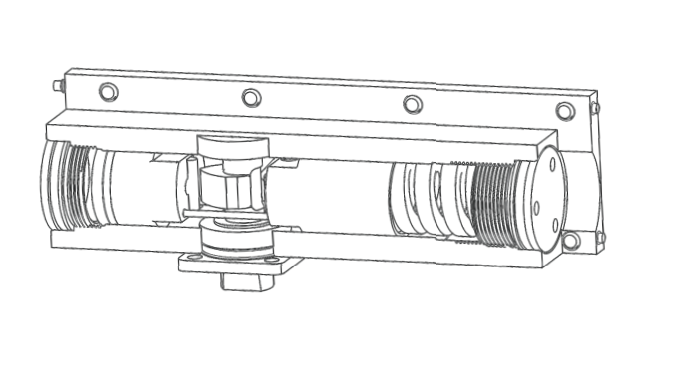
Step-by-Step: What Happens When You Open and Close the Door
● Initial Push – Engaging the Piston
As you push the door, your force is transferred to an internal piston within the hinge. The piston starts moving, pushing the hydraulic oil in closed chambers.
● Fluid Movement and Pressure Build-Up
The hydraulic oil is made to flow through small openings and valves as the piston moves. This is done to create pressure which results in resistance.
The resistance is not merely incidental. It is what makes the door appear to have that smooth, damped feel rather than a free-floating, uncontrolled action.
● Adjustable Valves – Controlling Speed
A large number of hydraulic pivot hinges have adjustable valves that regulate the amount of oil flow that may go through them. By adjusting these valves, installers can adjust the closing speed, soft-close feature and even the last latch.
Say, a storefront might require a more solid close to make the door close against weather strips, whereas a glass door in an office will be fitted for a feather-light finish.
● Soft-Close Action
As the door approaches the closed position, another set of hydraulic controls engages, which is the soft-close mechanism.
This slows the final few degrees of movement, preventing slamming. It also protects delicate glass panels and reduces noise.
● Latch Control and Final Engagement
For doors with latches, the hinge provides just enough hydraulic push at the very end to ensure the latch clicks securely into place. This balance, gentle but firm, comes from precise engineering of the pistons and valves.
● Self-Closing Function
The pressure stored in the hydraulic system reverses the movement of the piston once it has been released. This stored energy causes the hinge to draw the door back to its original position.
That is what makes these hinges self-closing, making it an important attribute in residential and commercial settings.
Why Use Hydraulic Pivot Hinges?
The hydraulic pivot hinges are not a mere fancy piece, but they have some practical advantages:
- Aesthetics: Their subtlety of installation leaves the attention to the door design. This is especially important for frameless glass doors, where visible hardware would break the clean lines.
- Durability: The hydraulic pivot hinge reduces wear and tear on the door’s frame and hardware. It does so by limiting movement, which increases the installation life.
- Safety: The soft-close action minimizes the chances of having trapped fingers or even the door slamming against the wind.
- Customization: The hinge can also be customized by adjustable settings to fit all environments. This could be an office needing some peace and quiet, a store entrance that is quite busy, or a heavy wooden door that is in one’s home.
Comparison to Other Systems
Prior to the popularity of hydraulic pivot hinges, the market was controlled by floor springs and overhead closers.
Floor springs are used similarly but tend to be larger and necessitate more invasive fitting beneath the flooring. Meanwhile, overhead closers may be noticeable and affect minimalist designs.
Both issues are addressed by pivot hinges, which are small, sturdy, and can be hidden without compromising functionality.
Real-World Applications
You’ll find hydraulic pivot hinges in:
- Commercial Entrances: Shopping malls, hotels and offices have heavy glass doors.
- Residential Interiors: Minimalist glass or wooden doors in luxury houses.
- Public Spaces: Museums, libraries, or galleries where an uninterrupted, smooth operation is necessary.
The hinge, in all these settings, has made sure that the hardware and the door are not worn out or damaged due to frequent use.
Maintenance and Longevity
Even though hydraulic pivot hinges are durable, they must be taken care of:
- Lubrication and Cleaning: With time, the pivot points may accumulate dust or debris. Wiping down these parts and inspecting seals are a way to keep the performance.
- Valve Adjustments: The seasonal changes in temperature or replacement of the doors may necessitate adjustment of the valves.
- Seal Integrity: The hydraulic system is made using oil-tight seals. If there is any observable oil leak or inconsistent closing, this indicates that the hinge may require service.
If properly maintained, a good hydraulic pivot hinge may last several years, even where there is a lot of traffic.
The Engineering Behind the Smoothness
Combining the mechanics and fluid dynamics with such precision is what makes these hinges so impressive.
Even the pistons are produced with tight tolerances. This ensures the hydraulic fluid flow is uniform and predictable. The calibration of the valves is also done carefully such that any minute changes will lead to an observation.
Such engineering makes it possible to have 100 kg doors feel light and graceful to the user.
Final Thoughts
A hydraulic pivot hinge may not appear a large detail in a building, but it has a large role in functionality and design. These hinges turn a normal door into what feels like a high-end product by utilizing the directed flow of hydraulic fluid.
The next time you pass through a frameless glass door and hear no slam and no resistance, you will understand that there is a job of engineering that does wonders behind the scenes.
