
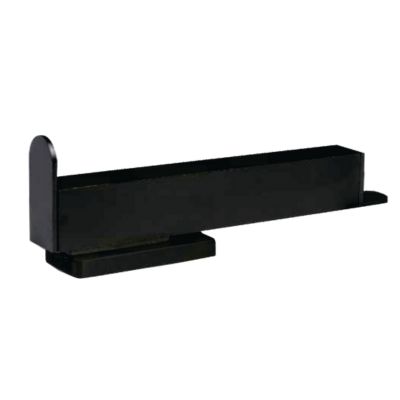
SH Hydraulic Pivot hinge PK Dorma Floor spring
When choosing hardware for a heavy door, the closing mechanism is easy to overlook. The vast majority of people think about the door, frame, glass or finish. The hardware that is installed under the door is something that most people don’t think about.
However, it does have an impact on the feel of the door over time.
For years, office buildings, hotels, apartments, and commercial buildings have employed floor springs. The Dormakaba BTS 55 is an example of this. It’s a small, compact floor spring that is used for doors up to 100kg and 950mm wide.
Hydraulic pivots offer another approach. The system can be operated by a hydraulic actuator installed with the door pivot, rather than under the floor. This concept is the basis of the SH Pivot models, including the D-1033 and the heavy-duty D-1068.300.
So, which system makes more sense?
Hydraulic pivot systems are becoming more and more commonplace in many contemporary door installations.
The Difference Starts With the Mechanism
Traditional closing mechanisms use a spring which is increasingly difficult to operate as the door moves open. The spring stores more energy during opening, then releases it as the door closes. However, the closing force can be decreased at the end of the closing cycle. This can lead to a less consistent final latching.
Cam-action technology approaches the problem differently.
The effective moment arm varies during the movement of the door, thanks to a uniquely shaped cam. This helps to balance varying spring forces, so that the operating force remains more uniform as the load is opened and closed.
This is one of the main reasons cam-shaft technology is important in hydraulic pivot systems. The door doesn’t just get heavier as it is opened. It’s designed to provide a more controlled and balanced motion.
SH Pivot goes one step further with its cam-shaft design.
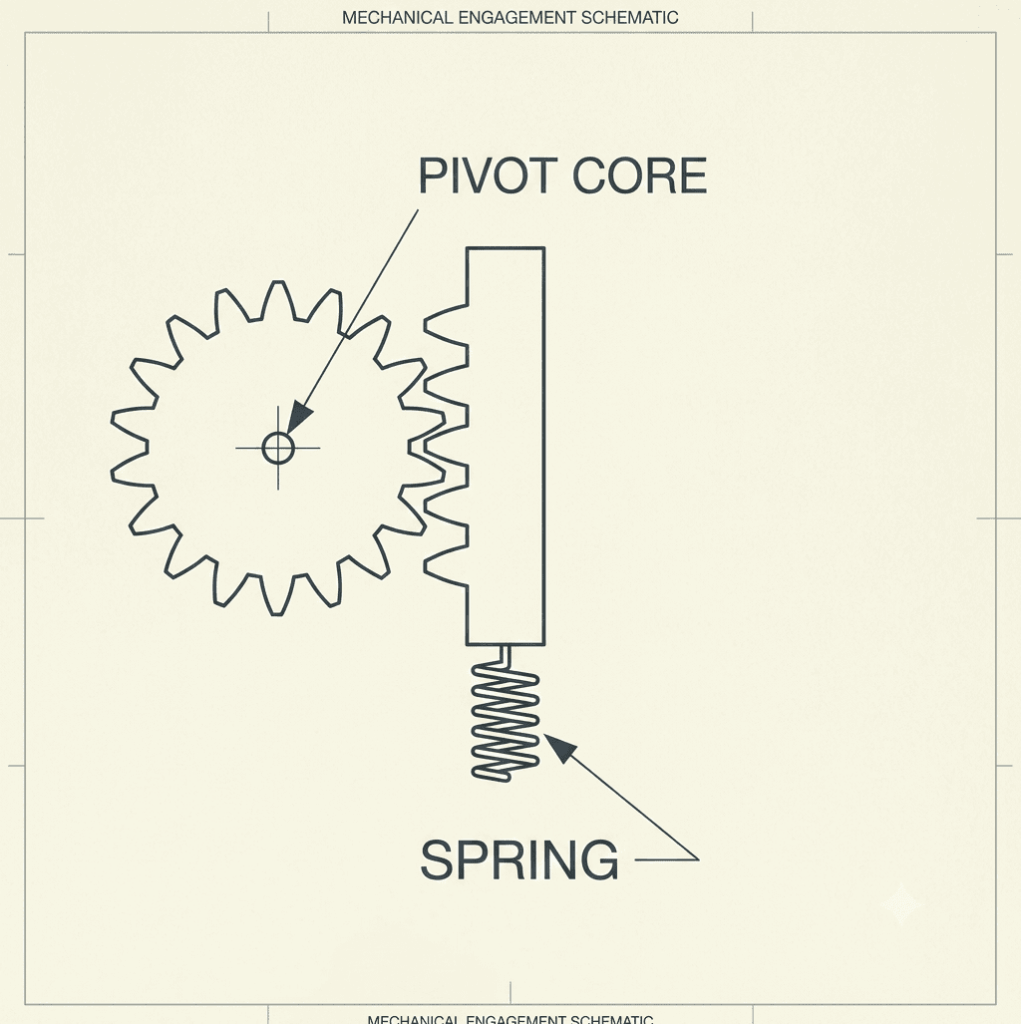
- Traditional door closers utilise asimple round gear and rack mechanism to compress the internal spring during door opening.
As you open the door, the spring is progressively compressed. The spring force keeps increasing, which makes the door feel heavier and heavier to operate. During closing, the spring extends back to its original length. The closing force gradually diminishes towards the end of the travel, resulting in insufficient locking force to fully secure the door.
Here is traditional floor spring work:
Most cam-action mechanisms available on the market are derived from Dorma’s design. Unlike regular circular profiles, the cam is irregularly shaped — for instance, SH Hydraulic pivot adopts a heart-shaped cam.
The core advantage of the cam structure is maintaining consistent operating force throughout opening and closing, independent of the progressive spring compression. It works by varying the torque via the contoured surface of the cam. The specially shaped cam profile adjusts the effective moment arm dynamically to offset the changing spring force, so the opening and closing feel remains steady.
The following show SH Hydraulic pivot working features:
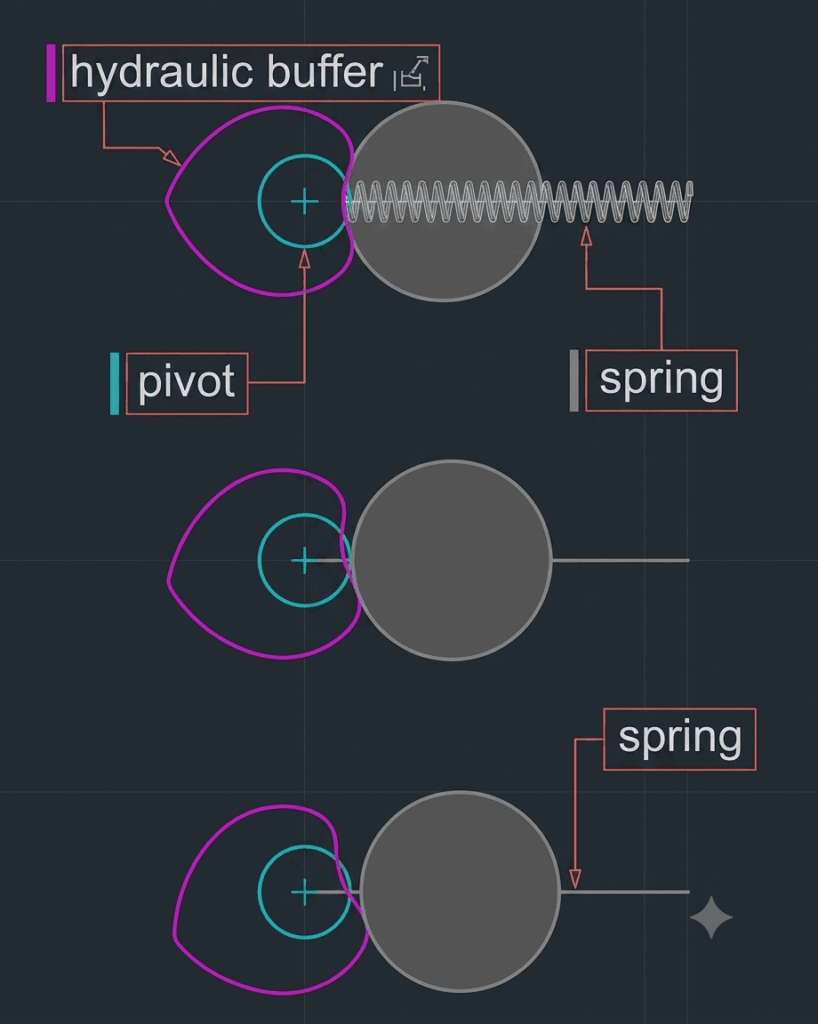
The cam-action pivot mechanism from SH Pivot is covered under our exclusive patent.
Most cam systems available on the market are evolved from Dorma’s design. Their spring assembly and hydraulic damping unit are arranged on opposite sides, which forces the pivot shaft to be positioned near the centre of the housing.
Our innovative cam structure enables the spring and hydraulic damping to be placed on the same side of the pivot. As a result, the pivot shaft can be offset to the edge of the housing. This delivers a major practical advantage: ultra-narrow gap when you opening your door.
The D-1033 is engineered for applications where a traditional concealed hinge or floor spring might not offer the strength and adjustment that is needed.
It is available for doors weighing up to 100 kg, depending on their configuration. The unit is built of 45 steel and high strength 304 stainless steel parts, enabling the unit to meet the strength requirement for regular commercial use.
One benefit of this is that it has a dual-stage regulating valve system. Rather than applying the closing movement to the entire product, the hydraulic control can be set in two steps. This enables the closing speed and final latching to be adjusted independently.
That matters in real-world use. A door can close smoothly through most of its travel while still having enough force during the final part of the movement.
The D-1033 is also capable of opening in both directions with a maximum opening angle of 125°. A 90° auxiliary positioning function is also available.
The design also makes installation easy. The adjustable base enables changes to be made with hexagonal screws. A pre-installed base is not required, which can help with easier positioning and installation on site.
The D-1033 has also undergone a 200,000 cycle fatigue test.
When 300 kg Changes the Equation
For larger and heavier doors, the SH D-1068.300 moves into a different category.
There are two versions in the D-1068 series: 200 kg and 300 kg. The door weight is up to 300kgs, and the width is up to 1500mm between the axis core to the edge of the door.
That’s much more than the 100 kg weight capacity of the Dormakaba BTS 55.
This D-1068.300 is constructed of 45 steel and features a forged bearing steel cam shaft. The cam shaft is waterproof and corrosion-proof and has a hydraulic closure system for controlled closing.
It also has two-stage regulating valve control and a 90° auxiliary positioning function. The door will swing open in both directions to 125°.
These differences are significant for a large wooden door or a large metal door. The D-1068.300 is not just being used as a regular floor spring. It is built based on the needs of much bulkier doors.
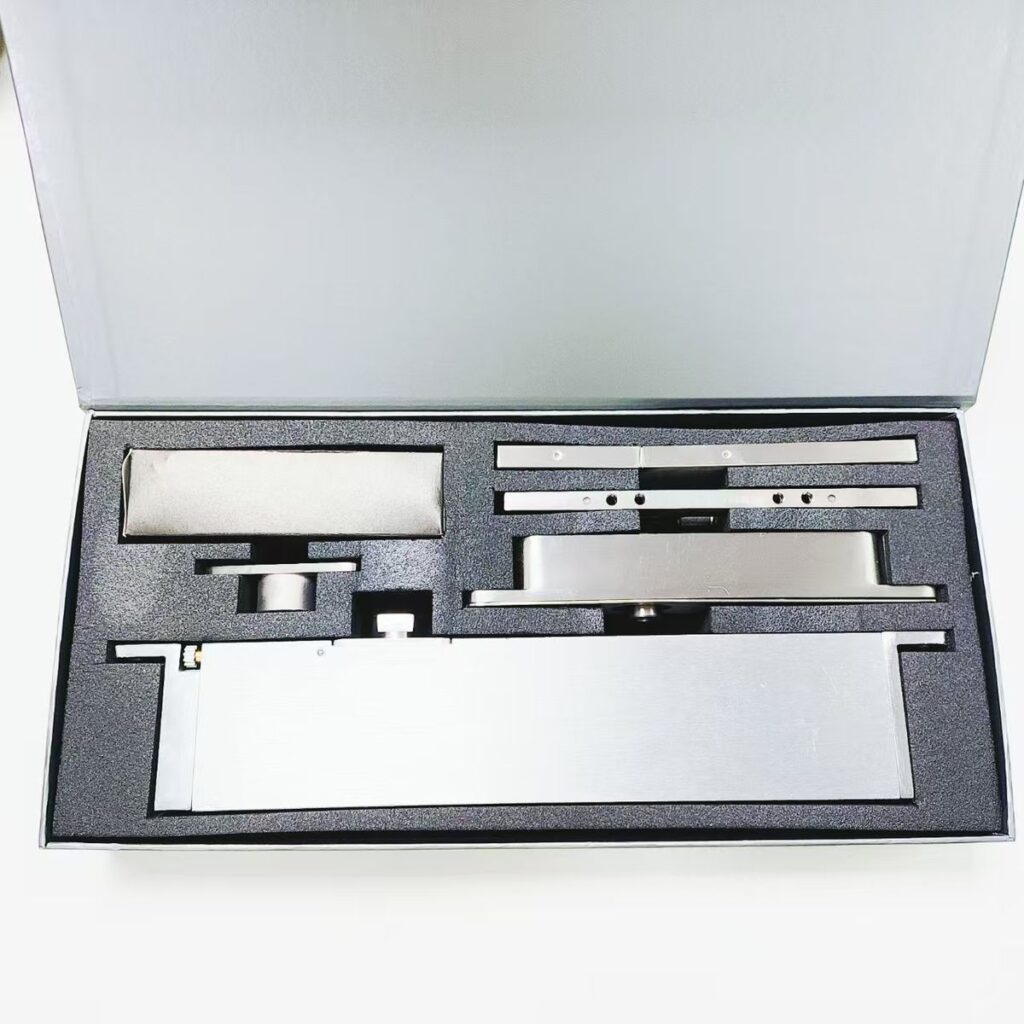
SH Hydraulic Pivot vs Dormakaba BTS 55
The Dormakaba BTS 55 remains a practical option for lighter internal and commercial doors. The all-slim 40 mm body and the easy-to-adjust closing speed and the optional hold-open function at 90° make it compatible with many standard installations.
It can be used to support doors weighing up to 100kg and up to 950mm in width. It is also designed to be used for a long time with a rated service life of over 500,000 cycles.
So why consider an SH Hydraulic Pivot instead?
This depends largely on the door and the installation.
For a standard 100 kg door, the BTS 55 may be sufficient. However, if the door becomes heavier, or if flexibility of installation and performance in hydraulic pivot is required, this is where the SH PIVOT system has more space to play.
The D-1033 covers applications up to 100 kg, while the D-1068.300 goes up to 300 kg. This is especially important for large entrance doors, heavy architectural doors and other challenging applications.
Installation Can Make a Big Difference
Floor springs are installed beneath the door. This means the floor has to accommodate the spring body and the installation needs to be properly planned.
This is not always the case for a new project. It can be more complex when the building is undergoing renovations or replacement.
SH’s hydraulic pivot design features an adjustable base. Hexagonal screws can be used to fine-tune the position without requiring a pre-embedded base.
That provides more flexibility for the installer.
The cam shaft design also brings about another practical difference. The spring and hydraulic damping parts are on the same side of the pivot in SH’s cam arrangement. This puts the pivot shaft closer to the edge of the housing, leaving a very small space when the door is opened.
This can be a handy feature for modern architectural doors, where clean lines and tight gaps are important.
Maintenance and Long-Term Cost
The cost of a door closer isn’t solely determined by its initial price.
The total cost of a project can be increased through installation time, adjustment, maintenance, and replacement.
Some of the work during installation can be minimized with a hydraulic pivot that does not require a pre-embedded floor box. It can also simplify replacement or adjustment when it is not desirable to change the construction of the floor.
The SH models are also designed around heavy-duty use. The D-1068 has passed a 500,000-cycle fatigue test, while the D-1033 has passed a 200,000-cycle test.
This is not to say that all SH pivots are automatically cheaper to operate throughout their life than all floor springs. The actual cost will vary according to the door, installation, and project needs. However, its ease of installation and versatility may make SH an economical choice in situations where floor springs are challenging to install or keep up.
Why Hydraulic Pivots Are Becoming More Popular
Hydraulic pivot systems are increasingly being considered for modern apartments, offices and hotels.
There’s a practical explanation for this.
Oftentimes these buildings feature large entrance doors that must be kept clean and used often. Designers also want fewer hardware components to be visible and installers want systems that are easily movable without extensive building changes.
Heavy glass, metal and architectural wooden doors are becoming popular. As door sizes increase, the limitations of lighter floor springs become more obvious.
That’s where heavy-duty hydraulic pivots are beginning to play an increasing role.
They have concealed hardware, controlled closing, high door carrying capacity and flexible installation, which can be used in projects with high requirements for appearance and performance.
Which One Should You Choose?
The decision between the SH Hydraulic Pivot and Dormakaba BTS 55 is ultimately a door and project decision.
For a lighter door within the BTS 55’s capacity, the Dormakaba system can be a sensible choice. It fits into a small package and is already built on a floor spring.
The SH Hydraulic Pivot is certainly worth considering for heavier doors, particularly if flexibility in installation is a critical factor.
Both the D-1033 and the D-1068.300 are powered by hydraulic control and feature two-stage hydraulic adjustment with the help of SH’s cam shaft technology.
The outcome is a door system that not only closes the door, but also facilitates and controls the whole process more smoothly.
Final Thoughts
A floor spring is still a useful solution for many doors. However, it’s not the only choice.
In contrast, SH Hydraulic Pivot uses hydraulic control paired with cam shaft and adjustable installation and heavy-duty construction.
In the case of standard doors, the difference might not be dramatic. However, it can be for large, heavy, or frequently used doors.
This is where the D-1033 and the D-1068.300 models come into play, especially for modern apartment buildings, offices, hotels and other commercial applications.
Where door weight, installation requirements, maintenance and long-term performance are all critical, a hydraulic pivot may be a more adaptable solution than a traditional floor spring.
